

Educational information only, not a diagnosis. Know when to get help.
On this page
Hematospermia (also spelled haematospermia, and sometimes called hemospermia) means blood in the semen, the fluid released when you ejaculate [Cleveland Clinic]. ICD-10-CM codes it as R36.1.
What it looks like
Blood in semen can look bright red if the bleeding is recent, or brown or reddish-brown when it's older blood clearing out. Sometimes there are small clots [NHS]. Pink-tinged semen is also common [Cleveland Clinic]. Many men only notice it once, on a condom or after masturbation.
Is it common?
Nobody knows exactly how common it is, because most men don't look closely at their semen and many episodes go unreported [AAFP]. In clinics it is seen most often in men between 30 and 40 [Cleveland Clinic], and one review estimates it accounts for about 1–1.5% of urology referrals [review].
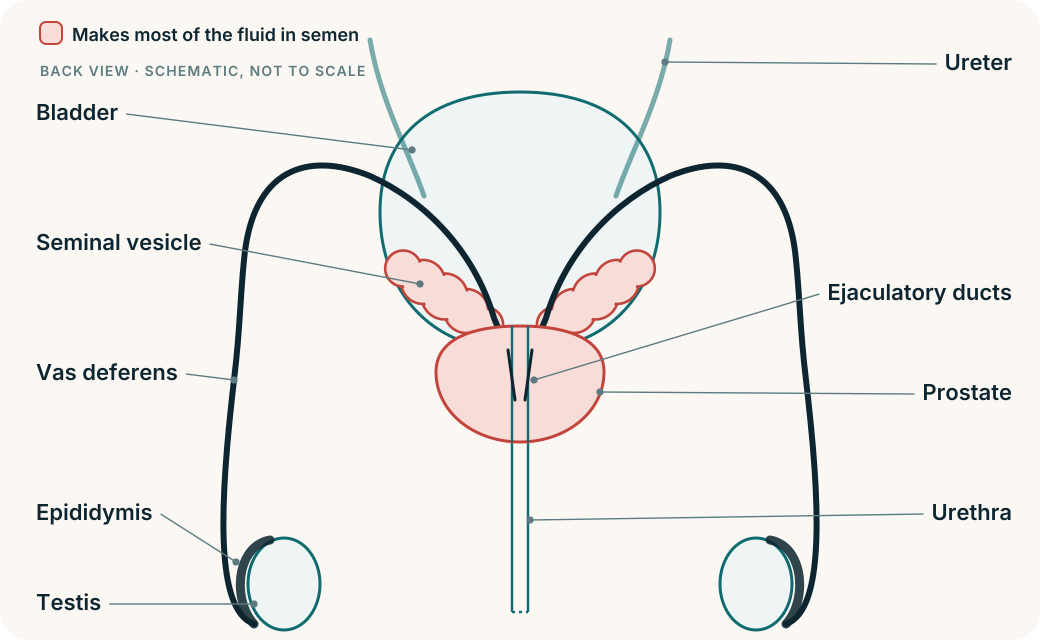
Where does the blood come from?
Semen is a mix of sperm from the testicles and fluid from the seminal vesicles, prostate and other small glands. Bleeding anywhere along that pathway can tint the semen [MSD Manual]. The most likely explanations are a small blood vessel that bursts during ejaculation (a bit like a nosebleed), a recent procedure such as a vasectomy or prostate biopsy, an injury, or an infection or inflammation [Cleveland Clinic]. See all causes.
Is it dangerous?
Usually not. Mayo Clinic notes that the cause is most often not cancer and that it most often goes away on its own [Mayo Clinic]. NHS advice is that it isn't usually caused by something serious, but you should get it checked by a doctor just in case [NHS].
The picture is different if you are 40 or older, if it keeps happening, or if you have other symptoms. Doctors are more thorough in those cases because a small number turn out to have a more important cause, such as prostate problems [NICE CKS] [AAFP]. See under 40 vs 40 and over.
Not blood in semen? Doctors also consider "pseudo-hematospermia": blood that is actually from the urine, or from a sexual partner [MSD Manual] [RACGP]. If you also see blood when you pee, read blood in urine and semen.
Does it affect fertility or sex?
NICE advises reassuring men that most causes don't affect fertility, with the exception of sexually transmitted infections such as chlamydia or gonorrhea [NICE CKS]. The MSD Manual notes that hematospermia doesn't affect sexual function [MSD Manual].
What to do next
- Note when you first saw it, how many times, and any other symptoms.
- Use the should-I-worry checklist to see how soon to get seen.
- Book an appointment with your GP, primary care clinician or a urologist. Read what tests to expect.
Sources
- Blood in Semen (Hematospermia) Cleveland Clinic Health Library, reviewed Jan 2024
- Blood in semen NHS, reviewed Sep 2025
- Evaluation and Treatment of Hematospermia American Family Physician, 2009;80(12):1421-1427
- Laboratory and clinical management of leukocytospermia and hematospermia: a review PubMed Central (PMC7290265)
- Hematospermia MSD Manual Professional Edition
- Blood in semen: causes Mayo Clinic
- Haematospermia: management NICE Clinical Knowledge Summaries
- Haematospermia Australian Family Physician (RACGP), Dec 2015
We link to primary medical sources so you can check our work. See the editorial policy and the full reference list.