

Educational information only, not a diagnosis. Know when to get help.
On this page
In many men no specific cause is ever found. A review on PubMed Central reports that roughly 30–70% of cases are idiopathic [review], and these usually settle by themselves. When a cause is found, it usually falls into one of the groups below.
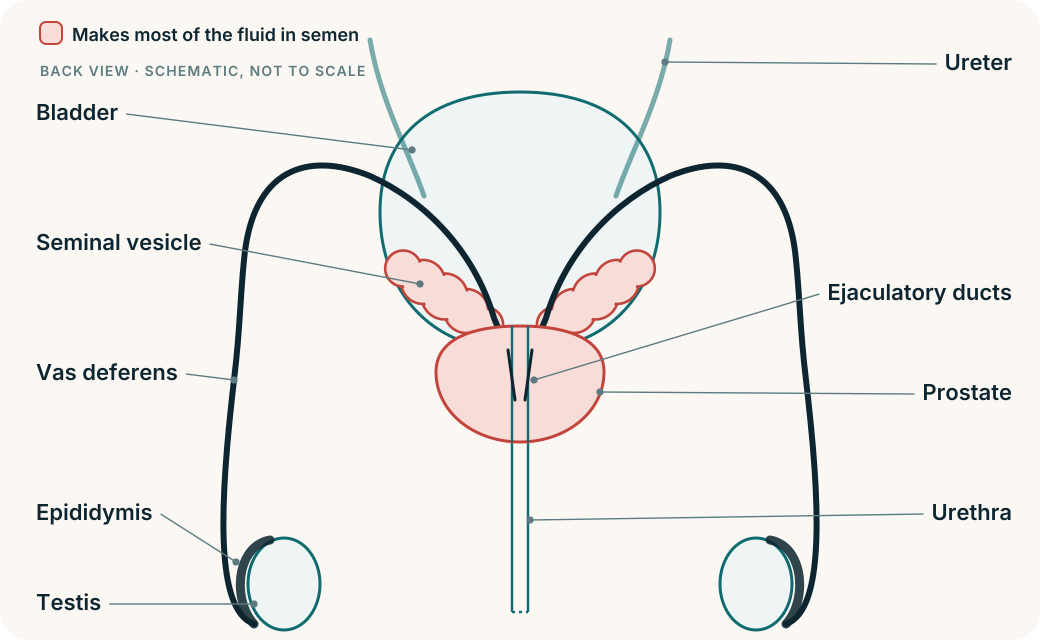
The most common causes
| Cause | What to know |
|---|---|
| A burst small blood vessel | One of the most likely causes. Like a nosebleed, a tiny vessel bursts during ejaculation [CC]. |
| Recent procedure | Prostate biopsy is the most common known cause [MSD]. Vasectomy, cystoscopy and TURP can cause it too [NHS]. See vasectomy and biopsy. |
| Infection | Urinary tract infections and STIs such as chlamydia and gonorrhea [NHS] [CC]. Infection is the most common cause in men under 40 [review]. See STIs and blood in semen. |
| Inflammation of the prostate or nearby glands | Prostatitis, epididymitis, orchitis, and inflammation of the seminal vesicles [CC]. See prostatitis. |
| Injury | Trauma to the testicles, prostate or nearby structures, including vigorous sex or a groin injury [CC]. |
| Enlarged prostate (BPH) | Benign prostatic hyperplasia, prostate cysts and polyps [CC] [MSD]. |
Less common causes
- Stones or cysts in the seminal vesicles or prostate [CC] [review].
- Blood clotting problems, including bleeding disorders and blood-thinning medicines, and conditions such as sickle cell disease or liver disease [CC] [NICE].
- Uncontrolled high blood pressure. Doctors check blood pressure as part of the workup [CC] [review].
- Prostate cancer treatment such as external beam radiation or brachytherapy [CC].
- Chronic infections such as tuberculosis, and schistosomiasis in people who have lived in or travelled to areas where it occurs [MSD].
Can it be cancer?
Rarely. Cancers of the prostate, testicle, bladder, seminal vesicles or urethra can be associated with blood in semen, but Cleveland Clinic notes it's rare for hematospermia to be the first symptom of these cancers [CC]. Mayo Clinic says the cause is most often not cancer [Mayo]. The risk of a serious cause is higher if you're over 40, if it keeps happening, or if you have other symptoms, which is why those groups are checked more carefully [NICE] [RACGP].
A hernia can't cause blood in semen, because it doesn't involve the structures that carry semen [CC].
Causes grouped the way doctors think about them
A 2017 review groups causes into ten mechanisms: inflammatory, infectious, stones, cysts, obstruction, tumors, vascular, traumatic, iatrogenic (caused by a medical procedure) and systemic (whole-body conditions such as bleeding disorders) [review]. Your doctor's questions about recent procedures, sex, medicines and other symptoms are aimed at narrowing down which group is most likely.
Sources
- Laboratory and clinical management of leukocytospermia and hematospermia: a review PubMed Central (PMC7290265)
- Blood in Semen (Hematospermia) Cleveland Clinic Health Library, reviewed Jan 2024
- Hematospermia MSD Manual Professional Edition
- Blood in semen NHS, reviewed Sep 2025
- Hematospermia: etiology, diagnosis, and treatment Review article, PubMed Central (PMC5904639)
- Etiologic classification, evaluation, and management of hematospermia Translational Andrology and Urology review, PubMed Central (PMC5673809)
- Haematospermia: management NICE Clinical Knowledge Summaries
- Blood in semen: causes Mayo Clinic
- Haematospermia Australian Family Physician (RACGP), Dec 2015
We link to primary medical sources so you can check our work. See the editorial policy and the full reference list.