

Educational information only, not a diagnosis. Know when to get help.
Age is one of the biggest factors in how doctors approach blood in semen. The cut-off most guidelines use is 40 [NICE CKS] [AAFP] [RACGP].
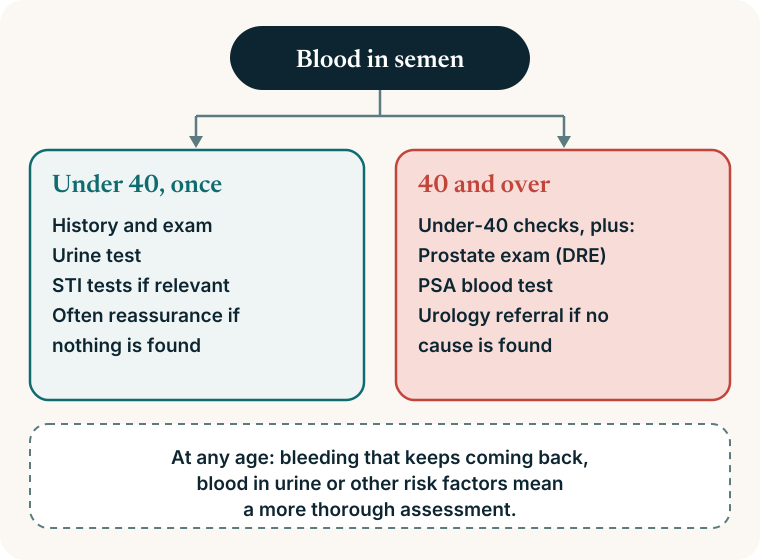
Under 40
In men under 40 without risk factors or other symptoms, hematospermia is usually self-limited [AAFP]. Infection of the urinary or genital tract is the most common identifiable cause [review].
- Typical checks: history, examination, urine test, and STI testing if relevant [AAFP] [MSD].
- If nothing is found after one episode, NICE advises reassurance and returning if it recurs [NICE].
- Seek further assessment at any age if it keeps happening or persists [NICE].
40 and over
From 40, doctors are more thorough, because the chance of an important underlying cause such as prostate disease is higher [NICE] [review]. That doesn't mean cancer is likely. In men 40 and older, a recent procedure such as a prostate biopsy is the most common cause [AAFP].
- Typical checks add a digital rectal exam of the prostate and a PSA blood test [RACGP] [AAFP].
- NICE advises referring all men over 40 to urology when no cause is found in primary care [NICE].
- A urologist may use ultrasound (including transrectal ultrasound), MRI or cystoscopy if needed [AAFP] [MSD].
Risk factors at any age
Guidance highlights these as reasons for a more thorough look: recurrent or persistent bleeding, blood in urine, a family history of prostate cancer, African or Black heritage (a prostate cancer risk factor), unexplained weight loss or bone pain, a bleeding disorder, or a history of cancer [RACGP] [healthdirect] [Mayo].
About PSA
PSA (prostate-specific antigen) is a blood test that can be raised by prostate cancer but also by an enlarged prostate, infection or recent procedures. A normal result doesn't rule out cancer, and an abnormal one usually needs repeating [StatPearls].
Sources
- Haematospermia: management NICE Clinical Knowledge Summaries
- Evaluation and Treatment of Hematospermia American Family Physician, 2009;80(12):1421-1427
- Haematospermia Australian Family Physician (RACGP), Dec 2015
- Hematospermia: etiology, diagnosis, and treatment Review article, PubMed Central (PMC5904639)
- Hematospermia MSD Manual Professional Edition
- Blood in semen (haematospermia) healthdirect Australia
- Blood in semen: when to see a doctor Mayo Clinic
- Prostate Cancer Screening StatPearls, NCBI Bookshelf (NBK556081)
We link to primary medical sources so you can check our work. See the editorial policy and the full reference list.